
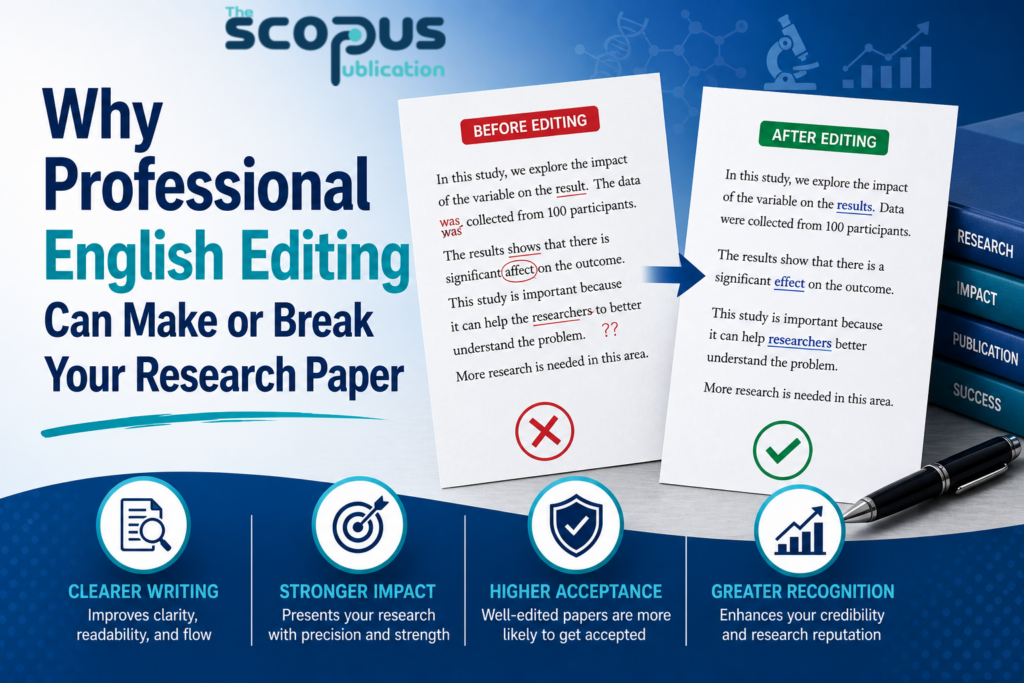
That research took three years to design. You gathered the data, performed the analysis and paid special attention to interpreting the results. However, herein lies the uncomfortable query: will incoherent English ensure that your work is not published?
The answer is often yes to many researchers and more so those who write in English as a second language. Among the factors that contributes to the rate of manuscript rejection among the top journals is the language barrier. Even the most innovative and good research can be delayed, rejected or misunderstood merely because the writing is not precise and clear.
This blog is your honest, useful, guide to understanding the definition of professional English editing, why it is important to the quality of academic writing and how to choose the proper service. By the end of it all, you will know quite well what is involved in editing your manuscript, how it will increase your chances of being accepted, and how to make the best choice when it comes to editing your manuscript.
What does professional English editing do for a research paper?
The editing of professional English enhances grammar, clear, structure, and academic tone that will ensure that your research is clear and easy to understand. It fixes any form of language errors, enhances readability and lets reviewers focus on your scientific contribution and not the poor readability in your writing.
Why Language Quality Directly Affects Journal Acceptance
What peer reviewers say about language issues
Peer reviewers and journal editors always mention poor language as one of the key causes of the rejection or a considerable number of revisions. Even good science is not good grammar makes a strain in the process of reviewing.
Big publishers such as Elsevier, Wiley and Springer specifically state that a clear, grammatically correct writing in English is required before submitting. Should your paper fall short of this minimum requirement, then you may even be deemed not to be a full peer review.
This puts a structural disadvantage on non-native English researchers. Your ideas might be equally strong but when they are more difficult to comprehend, there is less chance of their succeeding. Professional editing assists in bridging that gap.
Top 5 Reasons of Language-Related Manuscripts Rejections
The following are the most frequent reasons of rejection of manuscripts related to language:
Unclear abstract
The abstract does not present the contribution of the research in a quick and efficient manner.
Inconsistent terminology
The same concept is expressed using different words and this confuses the reader.
Grammar mistakes with regard to meaning.
Particularly harmful in methods and results sections.
Unnecessarily complicated sentence structure.
Passive and long sentences make reading and understanding difficult.
Incorrect academic tone
Non-standard or informal language that is not in line with journal requirements.
What Is English Manuscript Editing?
Proofreading vs. Editing vs. Substantive Editing — What’s the Difference?
It is important to understand the types of editing:
- Proofreading
Correct spelling, punctuation and typing errors only. It fails to enhance readability and organization.
- Copy-editing / Language editing
This is what professional English editing is all about. It enhances grammar, sentence structure, word choice, and readability.
- Substantive editing
Comes further, polishing argument flow, structure and logical consistency throughout the manuscript.
What Does Correction of an English Manuscript Actually Include?
An excellent editing service normally includes:
- Correction of grammar, syntax and tense.
- Subject-verb agreement consistency
- Academic vocabulary enhancement
- Simplification of sentences to make them clear.
Flow and readability enhancement.
- Formatting according to journal requirements (APA, Vancouver, etc.)
- Stability in vocabulary and abbreviations
Concisely, it helps in polishing your manuscript to make it a publication-ready document.
How professional English editing services help researchers
Enhanced Transparency = Enhanced Peer Review Results.
When your writing is clear, readers are able to concentrate on your research- not your language.
This directly affects the results:
- Fewer misunderstandings
- More constructive feedback
- Increased chances of advancing to desk rejection.
A professional manuscript means that it is professional and credible the first time one reads it.
Benefits for non-native English speaking researchers
Professional editing can be of great benefit to ESL researchers:
- Equalizes the playing field with the native English writers.
- Minimizing the number of revision cycles, it saves time and effort.
- Improves writing abilities by professional feedback.
It is not merely about a single paper, but rather an investment in your overall academic communication potential, down the line.
From Submission to Acceptance — The Role of Language Polish
Numerous journals today are specifically acknowledging the significance of quality of language:
- Some of them provide expedited reviews of well-edited manuscripts.
- Others would suggest or would demand an editing certificate.
This is involved in a mere fact: the quality of language is an indicator of the readiness of a manuscript.
What to look for in academic editing services
5 Questions to Ask Before Choosing an Academic Editing Service
Prior to choosing a provider, enquire:
- Are the editors qualified in my subject area?
This makes sure that there is no loss of technical accuracy.
- Is an editing certificate provided?
Helpful with journal submission needs.
- What is the turnaround time, and are rush options available?
Particularly significant when it comes to time.
- Is a free sample edit or revision guarantee offered?
Refers to the trust in the quality of services.
- How is confidentiality protected?
Your study should not be compromised.
Red Flags to Avoid in Editing Providers
Watch out in case you see:
- No subject-specific editors
- Very low prices (usually automated editing)
- None of the certificates or credentials.
- No revision policy
- Lack of transparency
Before you submit , language quality checklist
Check the following 10-point checklist before submitting:
- Abstract has clear problem, method, results, and conclusion.
- The terminology is used uniformly.
- Figures and tables are well captioned.
- There is consistent tense use.
- Sentences are short (preferably less than 25 words)
- Active voice is used where appropriate
- No colloquialism or slang.
- References are done in journal style.
- Any abbreviations are explained.
- The manuscript can be read clearly when read aloud.
Real impact — before & after editing examples
Before & After: How Editing Transforms Writing
Example 1 (Results section)
BEFORE:
The outcome of the experiment was found to be exhibiting significant differences between the groups that was studied.
AFTER:
The experiment findings indicated that there were major differences between the study samples.
Example 2 (Abstract)
BEFORE:
This paper is attempting to explore the impacts that are occurring as a result of climatic changes in cities.
AFTER:
In the present research, the impact of climate change on urban settings is examined.
Example 3 (Discussion)
BEFORE:
One can say that the results are more or less significant and can be applied in the future studies.
AFTER:
These results are also important and serve as a basis in the way future studies are conducted.
These changes might not look much- but they are going to drastically enhance clarity, professionalism, and impact.
Frequently Asked Questions
It is a service that enhances grammar, clarity, and academic tone such that it meets journal standards.
It guarantees that reviewers are able to get a clear understanding of your research thus eliminating chances of being rejected.
Proofreading: Surface errors are fixed, whereas editing enhances clarity and organization.
It is suggested or even mandated in some journals, particularly when the author is not a native speaker of English.
Average 2-7 days, based on the length of the manuscript and the level of service.
Yes, particularly among ESL researchers who aspire to be published in high-impact journals.
Conclusion
Language is not merely a cosmetic coating, it actually defines whether your study will be published or not.
Even the best data or insights that you may have, when it comes to writing, you would not want to commit the mistake of letting your work go to waste. Editing your professional English paper will help you not only to achieve academic standards of the world, but also to convey your personal ideas to your target audience.
When you have spent many years of your life conducting your research, then it is reasonable to spend time on how it is presented.
Have professional manuscript eyes on your work – get your editing quote now.