
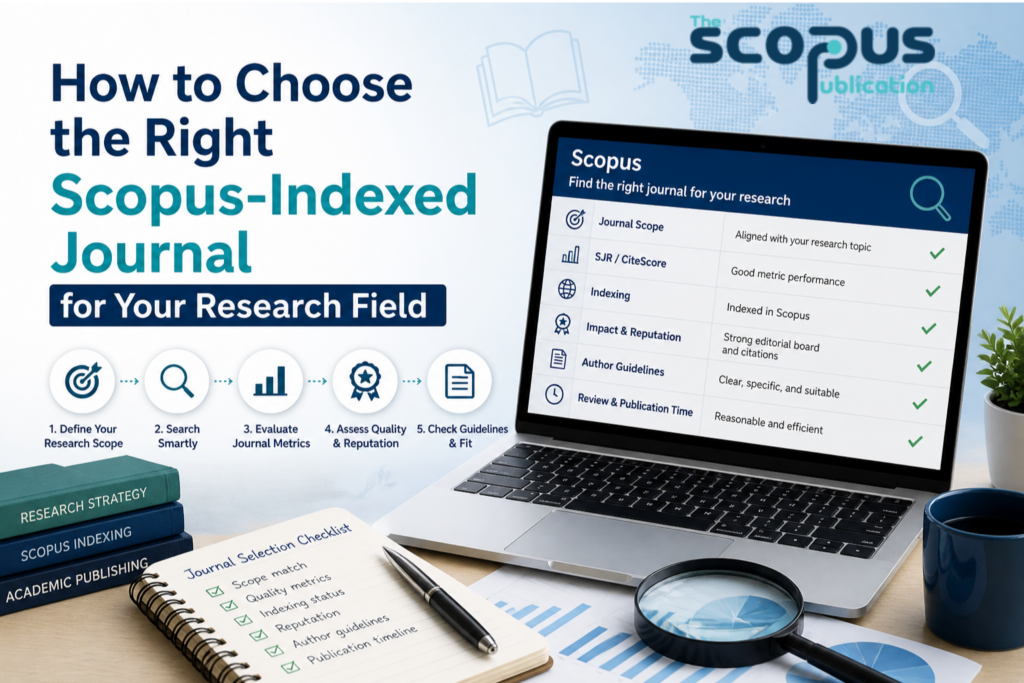
Submitting a research paper to the wrong journal does not just result in a rejection letter, it costs you time. Anywhere from three to twelve months of reformatting, resubmission cycles, and reviewer feedback rounds that could have been avoided entirely with more informed journal selection upfront. Most researchers experience this at least once. Many experience it repeatedly.
The scale of the challenge is significant. Scopus currently indexes over 27,950 active peer-reviewed journals across every academic discipline. Navigating that landscape without a structured approach means relying on word-of-mouth, habit, or guesswork. None of which hold up against a promotion deadline or a grant application requirement.
For researchers working in UAE universities, the stakes are particularly concrete. Research output targets are now embedded in institutional KPIs and promotion criteria at most accredited universities. Publishing in a Scopus-indexed journal is no longer an optional academic achievement, it is a career-defining institutional requirement.
This guide provides a practical, step-by-step framework for matching any research paper to the right Scopus indexed journal UAE. It covers the metrics that matter, how to read quartile rankings, scope alignment strategies that reduce desk rejection risk, predatory journal verification, and when open access titles offer a genuine strategic advantage.
Why Scopus Indexing Is the Standard for Research Quality
What Makes Scopus the Global Benchmark
Scopus is the world’s largest abstract and citation database, indexing over 27,950 peer-reviewed journals, more than 200,000 books, and over 10 million conference papers across every academic discipline. Its scale alone makes it the default reference point for research quality assessment globally.
Entry into Scopus is not automatic. Journals must pass the evaluation criteria set by Scopus’s Content Selection and Advisory Board (CSAB), which assesses editorial quality, peer review rigour, citation impact, and adherence to publishing ethics standards. That selection process is what gives Scopus indexing its credibility as a quality signal.
A Scopus-indexed publication provides verifiable international credibility that institutional databases, Google Scholar listings, or unindexed open-access journals simply cannot replicate regardless of their readership size or download numbers.
Why UAE Researchers Must Publish in Scopus Indexed Journals
The UAE Ministry of Education’s research performance frameworks explicitly mandate Scopus-indexed publications for faculty promotion at most accredited universities. This is not informal guidance it is a formal criterion embedded in the evaluation structure that governs progression from assistant to associate to full professor.
UAE Vision 2031 research goals tie institutional funding allocations directly to Scopus publication output. For many universities, this means that Scopus-indexed publications are not just a personal career goal for individual researchers, they are a direct institutional funding variable. The pressure flows both ways.
International research collaborations increasingly require lead researchers to hold a verified Scopus author profile with indexed publications. For UAE researchers seeking to build cross-border research partnerships, Scopus indexing is the baseline credibility requirement that opens doors.
What Happens When You Publish in a Non-Scopus Journal
Publications in non-indexed journals do not count toward UAE research KPIs regardless of the journal’s quality, reputation, or impact in other regions. A paper published in a highly regarded field-specific journal that is not Scopus-indexed is, from an institutional reporting perspective, invisible.
Reformatting and resubmitting to a Scopus journal after initial non-indexed publication is both time-consuming and sometimes impossible. Many Scopus-indexed journals will not consider manuscripts that have already been published elsewhere, even in a non-indexed venue, due to prior publication policies. The error is difficult to reverse.
Understanding Scopus Journal Metrics Before You Choose
Impact Factor: What It Measures and What It Does Not
Impact Factor (IF) measures the average number of citations received per paper published in a journal during the two preceding years. It is calculated and published annually by Clarivate through the Journal Citation Reports (JCR). It remains the most widely referenced journal quality metric in academic circles.
One important clarification that many researchers miss: Impact Factor is a JCR metric, not a Scopus metric. Not all Scopus-indexed journals have an IF, but virtually all journals with an IF are Scopus-indexed. The two systems overlap significantly but are not equivalent. Conflating them leads to flawed journal selection decisions.
More importantly, a high Impact Factor does not mean a journal is the best match for your paper. Scope alignment how well your research topic fits what the journal actually publishes is a stronger predictor of acceptance than prestige alone. Chasing a prestigious journal with a weak scope match is a reliable route to desk rejection.
CiteScore: Scopus’s Native Quality Metric
CiteScore is Scopus’s equivalent to Impact Factor. Calculated over a four-year citation window and published annually through the Scopus Source List and SCImago, it provides a broader and more stable measure of journal quality than the two-year IF window.
As a general benchmark: a CiteScore of 2.0 or above is considered respectable across most disciplines; 5.0 or above indicates an established, high-quality journal; and 10 or above reflects top-tier status. CiteScore is particularly more representative than IF for newer journals and for disciplines with longer citation half-lives, such as social sciences and humanities.
SJR, SNIP & Quartile Rankings: Reading the Full Picture
No single metric tells the complete story of a journal’s standing. The table below summarises the four key metrics researchers should understand before selecting a journal:
| Metric | What It Measures | Best Used For | Where to Find |
| CiteScore | Average citations per document (4-year window) | General quality benchmark | Scopus.com / Source List |
| SJR (SCImago) | Weighted citations by source prestige | Comparing journals across fields | SCImago Journal Rank |
| SNIP | Citation impact relative to field norms | Cross-discipline comparisons | CWTS Leiden / Scopus |
| Impact Factor (JCR) | Average citations per paper (2-year window) | High-prestige journal targeting | Clarivate JCR Portal |
| Quartile (Q1–Q4) | Relative journal position within subject field | Promotion & KPI compliance | SCImago / SJR database |
SJR (SCImago Journal Rank) weights citations by the prestige of the citing source a citation from a high-ranking journal carries more weight than one from a lower-ranked title. SNIP (Source Normalised Impact per Paper) adjusts citation counts relative to field-specific citation norms, making it the most reliable tool for comparing journals across different disciplines. Used together, these metrics provide a more complete picture than any single number in isolation.
Q1, Q2, Q3, Q4: Targeting the Right Quartile for Your Career Stage
What Quartiles Mean in the Scopus System
Scopus journals are ranked into four quartiles within each subject category Q1 representing the top 25% by SJR score, Q4 the bottom 25%. Quartile ranking is a relative measure: a journal’s quartile can differ depending on which subject category it is assessed under, so researchers should always verify quartile standing within their specific field.
For UAE researchers, Q1 and Q2 journals represent the standard institutional expectation. Most UAE university promotion frameworks explicitly require Q1 or Q2 publications to count toward annual research KPI targets. Q3 and Q4 journals remain valid Scopus-indexed publications but they carry significantly less institutional weight for promotion decisions and research funding applications.
Quartile Strategy by Career Stage and Research Goal
Matching your quartile target to your career stage is one of the most practical decisions in the journal selection process. The table below provides a working framework:
| Researcher Profile | Recommended Target | Rationale |
| PhD Student (first publication) | Q2–Q3 Scopus | Builds an indexed profile; sets realistic acceptance expectations; faster review cycles |
| Post-doctoral Researcher | Q1–Q2 Scopus | Establishes a citation footprint; required for fellowship and grant applications |
| Assistant Professor (UAE) | Q1–Q2 Scopus | Mandatory for most UAE university promotion from assistant to associate level |
| Associate / Full Professor | Q1 Scopus + Impact Factor journals | Maximises citation impact; supports research funding bids and international collaborations |
| Independent Researcher (UAE) | Q1–Q3 Scopus depending on field | Depends on institutional affiliation; Q1–Q2 preferred for institutional recognition |
The logic here is straightforward: early-career researchers benefit from building an indexed publication record, even if initial publications sit in Q2 or Q3. Mid-career and senior researchers need to demonstrate consistent Q1 impact to meet promotion thresholds and attract competitive grant funding.
How to Look Up a Journal’s Current Quartile Ranking
The most reliable tools for quartile verification are free and publicly accessible. SCImago Journal Rank (scimagojr.com) is updated annually and allows researchers to search by journal title or ISSN to view SJR score, quartile rank, and subject category including how a journal is ranked across different fields it covers.
The definitive source for Scopus indexing status is the official Scopus Source List, available at scopus.com/sources. Always verify a journal’s current indexing status here before submission Scopus periodically removes journals that no longer meet its quality standards, and a journal indexed when you last checked may no longer be active.
How to Match Your Paper to the Right Journal Scope
Why Scope Mismatch Is the Leading Cause of Desk Rejection
Desk rejection: Rejection without external peer review accounts for between 30% and 70% of all manuscript rejections at high-ranking journals. The most common reason: the submitted paper falls outside the journal’s declared scope. An editor who receives a paper that clearly does not match what their journal publishes will reject it immediately, regardless of the paper’s quality, methodology, or novelty.
This is the rejection that feels most avoidable in hindsight and it is. A careful scope-matching process before submission eliminates the majority of desk rejection risk.
Step-by-Step Journal Scope Matching Process
- Read the journal’s Aims and Scope page in full, not just the title. Many journals with broad-sounding titles have very specific topical mandates that narrow their actual focus considerably.
- Review the last three years of published articles in the journal. Do they resemble your paper in methodology, subject area, geographic focus, and theoretical framing? If your paper looks nothing like what the journal has been publishing, that is a scope mismatch signal.
- Search for your paper’s core keywords within the journal’s article database. If fewer than five results appear, your topic may be too niche or too peripheral for that journal’s readership.
- Review the editorial board composition. Board members’ research specialisms are a direct signal of the manuscript types that will receive the most engaged peer review.
- Use AI-assisted journal matching tools Elsevier’s Journal Finder, Springer’s Journal Suggester, or JANE (Journal/Author Name Estimator) to match your abstract to indexed journals by content similarity. These tools are free and can surface relevant journals you may not have encountered through manual search.
The One-Sentence Scope Test
Before running any metric comparison, apply this filter: can you describe your paper’s main contribution in a single sentence that directly echoes a phrase from the journal’s Aims and Scope? If the answer is no, the scope alignment is weak and the rejection risk is high.
Identifying and Avoiding Predatory Journals
What Is a Predatory Journal and Why It Matters for UAE Researchers
Predatory journals charge Article Processing Charges (APCs) without delivering genuine peer review, credible editorial oversight, or legitimate indexing in reputable databases. Their business model is volume-based fee collection, not academic quality. The research they publish receives no meaningful scrutiny.
A growing number of predatory journals falsely claim Scopus or Web of Science indexing, a problem that has caught UAE researchers and their institutions off-guard. The false claim is sometimes explicit (a direct statement on the journal’s website) and sometimes more subtle (referencing outdated indexing that has since been revoked). Verification is essential.
Publishing in a predatory journal even unknowingly carries serious consequences: the publication will be excluded from institutional KPI reporting, reputational damage can follow, and APC fees (typically USD 200 to 2,000 or more) are unrecoverable. The paper also cannot usually be republished in a legitimate journal.
The Four Warning Signs of a Predatory Journal
- Unsolicited invitation emails promising fast publication, guaranteed acceptance, or unusually high impact factors. Legitimate journals do not issue personalised acceptance guarantees before peer review.
- Publication timelines of fewer than two weeks from submission to acceptance. Credible peer review takes a minimum of four to sixteen weeks. Any faster timeline indicates that no genuine review occurred.
- APC fees requested before peer review is complete, or fees that appear unusually low under USD 200 for journals claiming Scopus indexing. Legitimate Scopus-indexed open access journals typically charge between USD 500 and 3,500.
- Journal titles that mimic established publications. Patterns like ‘International Journal of Advanced Research in [Field]’ or ‘Global Journal of [Discipline] Science’ are extremely common in predatory publishing.
How to Verify a Journal Is Genuinely Scopus-Indexed
Always verify directly on the official Scopus Source List at scopus.com/sources. Search by the journal’s ISSN not just its title, as predatory journals sometimes use names nearly identical to legitimate publications. A verified active listing is the only definitive confirmation of current Scopus indexing.
Cross-reference with Beall’s List of Potential Predatory Journals and Publishers, maintained via cabells.com. Beall’s List is the industry-standard reference for predatory journal identification and is updated regularly as new titles emerge.
Key verification resources: Scopus Source List | Beall’s List
Open Access Journals — Balancing Visibility and Reputation
Gold, Green, and Hybrid Open Access: What UAE Researchers Need to Know
Open access is not a single model. Understanding the distinctions matters for budgeting, institutional compliance, and citation strategy:
- Gold Open Access: the published article is immediately freely accessible online. The author or their institution pays an Article Processing Charge (APC) typically USD 500 to 3,500 for legitimate Scopus-indexed journals. Maximum visibility from day one.
- Green Open Access: authors self-archive a pre-print or accepted manuscript in an institutional or subject repository platforms such as ResearchGate, SSRN, or UAE institutional repositories. The final published version may remain behind a paywall, but a freely accessible version exists.
- Hybrid: the journal is subscription-based but offers an open access option for individual articles at APC cost. Increases visibility for the specific paper without requiring the journal to be fully open access.
Should UAE Researchers Prioritise Open Access Scopus Journals?
The evidence on open access and citation impact is consistent: open access Scopus journals achieve higher citation rates. Visibility and citability are directly correlated, and citability is what drives CiteScore and SJR improvements over time. For researchers whose institutional metrics depend on citation impact, open access publication carries a measurable advantage.
For funded research in the UAE, the question may not be optional. Several UAE research funding bodies including ADEC and KHDA-aligned grants, now mandate open access publication for research supported by their funding. Researchers working on funded projects should verify open access requirements before selecting a journal.
The assumption that open access equates to lower quality is demonstrably false for Scopus-indexed titles. High-quality Q1 and Q2 open access Scopus journals exist in every discipline. The Directory of Open Access Journals (DOAJ) at doaj.org allows researchers to filter by Scopus indexing, providing a curated list of quality-verified open access options.
A Step-by-Step Journal Selection Framework
The 6-Step Scopus Journal Selection Process
- Define your paper’s core contribution in one sentence, methodology type, discipline, geographic focus, and primary novelty claim. This sentence will serve as your scope-matching anchor throughout the process.
- Identify your target quartile based on career stage, institutional requirements, and realistic submission timeline. Q1 is the optimal target; Q2 to Q3 are more accessible with faster review cycles for researchers building their initial indexed publication record.
- Search the Scopus Source List (scopus.com/sources) and SCImago (scimagojr.com) for journals in your subject category. Filter by quartile, CiteScore range, and access type to generate an initial longlist of 10 to 15 candidate titles.
- Apply the scope matching process to a shortlist of five to eight candidate journals. Eliminate any with scope mismatch, predatory indicators, or indexing that cannot be verified on the official Scopus Source List.
- Check author guidelines, word count limits, referencing style, and typical time-to-decision for your shortlisted journals. This information is available on every journal’s official homepage and is a critical practical filter.
- Rank your shortlist by: scope alignment (most important), then quartile ranking, then CiteScore, then publication speed, then APC cost. Submit to your top-ranked journal first.
Building a Submission Cascade Plan
A submission cascade is a pre-planned list of three to five journals in priority order, constructed before you submit to your first choice, not after a rejection arrives. The cascade allows the next submission to proceed within days of a rejection decision rather than requiring weeks of fresh research.
Structure your cascade across quartile tiers: Target 1 should be your optimal Q1 or high-Q2 choice; Target 2 a solid Q2 with a strong scope match; Target 3 a Q2 or Q3 journal with faster review cycles. Each journal in the cascade should have a pre-verified scope match and confirmed active Scopus indexing. Do not wait for a rejection to research the next option, build the full cascade before you submit.
When to Use Professional Journal Publication Services
Signs You Need Expert Support
The journal selection process is learnable, but it is also time-consuming, requires familiarity with multiple databases and metrics systems, and has a significant margin for costly error. Professional support has measurable value in specific circumstances:
- You have received two or more desk rejections from journals in your target quartile. This pattern typically signals a scope mismatch or manuscript presentation issue that an experienced publication consultant can identify and address.
- Your institution requires a Q1 publication within a specific timeframe, for a promotion review or grant renewal and you cannot afford further trial-and-error submission cycles.
- You are an international researcher unfamiliar with UAE-specific journal preferences, institutional open access requirements, or regional publishing norms that affect journal selection.
- Peer reviewers have previously cited language quality as a rejection reason. Professional manuscript editing before submission significantly improves acceptance rates in this scenario.
What Scopus Journal Publication Assistance Typically Includes
Reputable academic publishing consultancies provide structured support across the full submission process from journal identification through to accepted publication:
- Journal identification and scope-matching analysis, matching your manuscript to the three to five most appropriate Scopus-indexed journals based on field, quartile target, and timeline.
- Manuscript formatting and compliance checking to ensure your paper meets the target journal’s exact author guidelines before submission a frequent source of unnecessary desk rejection.
- Cover letter drafting: a compelling, journal-specific cover letter that articulates the paper’s fit with the journal’s scope and readership, addressing the key question every editor asks why does this paper belong in this journal?
- Reviewer response support: expert guidance on responding to reviewer comments during the revision phase. This is the stage where many papers are lost despite successfully passing initial peer review.
Frequently Asked Questions
Typically 3–12 months from submission to publication. Q1 journals trend longer due to rigorous review; Q2/Q3 are generally faster. Factor speed into your journal selection if you have institutional deadlines.
Q1 = top 25% by SJR score; Q2 = 25th–50th percentile. Both are accepted in UAE promotion frameworks. Q1 carries more weight for grants and international profile-building. Q2 offers higher acceptance rates and faster timelines often the smarter target for early-career researchers.
Check the official Scopus Source List at scopus.com/sources using the journal’s ISSN (not just its name). Confirm the status is active, not discontinued. Cross-check against Beall’s List (beallslist.net) for predatory journals. Never rely solely on a journal’s own website claim.
No. Many operate on a subscription model with no author fees. APCs apply mainly to gold open access or hybrid journals. Filter by scope and quartile first apply cost as a final filter.
No. And any that claims to is a red flag. Legitimate services improve submission quality, scope alignment, and guideline compliance, all of which raise your chances. Peer review outcomes ultimately depend on research quality and factors outside any consultant’s control.
Choosing the Right Journal — A Decision Framework, Not a Guess
The right Scopus-indexed journal for any given paper sits at the intersection of four factors: scope alignment, quartile ranking, metric credibility, and verified freedom from predatory indicators. Prestige alone chasing the highest-ranking journal regardless of fit is the most expensive shortcut in academic publishing.
For researchers at UAE universities, the cost of a wrong journal choice is measured in months of career time. With research output KPIs tied directly to institutional funding, promotion criteria, and UAE Vision 2031 targets, a missed submission cycle is not merely an academic inconvenience it is a concrete setback with institutional consequences.
The good news is that the process is learnable. The Scopus Source List, SCImago, CiteScore rankings, and journal scope pages are all publicly accessible tools. Applied systematically using the six-step framework outlined in this guide they are sufficient to identify the right journal for any paper in any discipline.
Where that process runs into time constraints, prior rejection patterns, or institutional deadline pressure, professional guidance has clear and measurable value. The expertise gap between an experienced publication consultant and a researcher navigating journal selection independently narrows over time but the deadline does not.
Get your research published in the right Scopus-indexed journal
with expert guidance TODAY!
Our academic publishing consultancy has guided 500+ researchers to successful Q1/Q2 publications, journal selection, scope matching, formatting, and cover letter drafting included.