
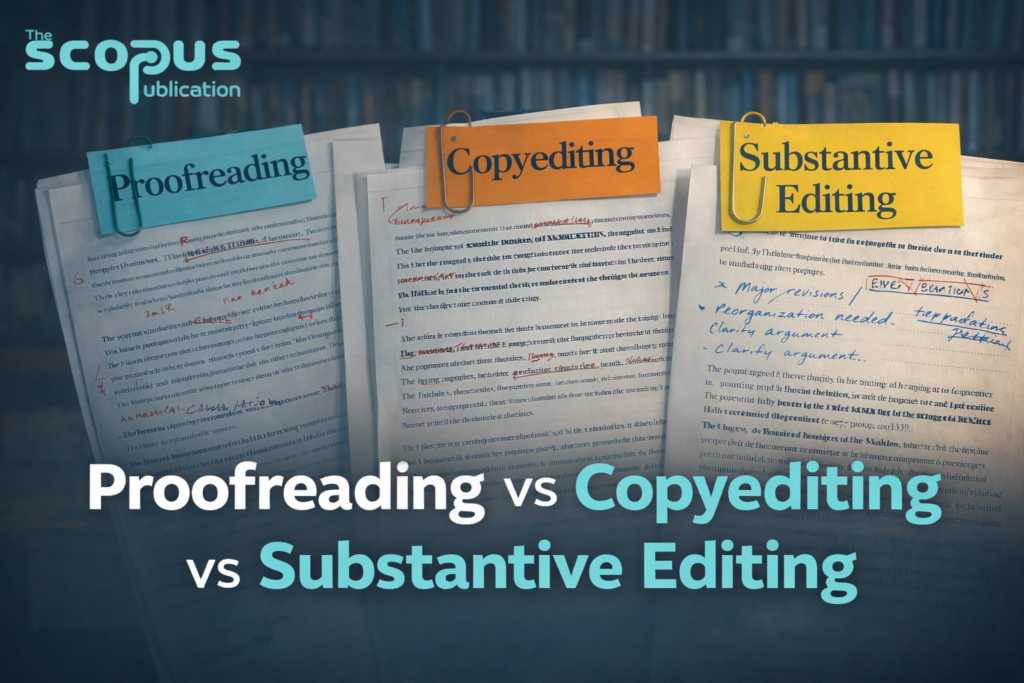
Formatting, correcting grammar, making it clear, revising the structure, journal formatting, and so on, is enough to make the experienced researchers shudder. This misunderstanding gets even more complex when it comes to preparing an article, a thesis, or a research paper, and you simply cannot tell whether you should get substantive editing, copyediting, or simply go through it with the help of proofreading. Proofreading Vs Copyediting Vs Substantive Editing are actually three levels of editing. Most authors presume that all editing companies accomplish the same task, but every phase has a totally different purpose in the manuscript revision process. The better news is that when you get the difference with a simple analogy, then you will find it easy to make a choice concerning the appropriate service.
Types of Editing Services
Here it is: Consider your manuscript a house-building.
- The architectural stage is the substantive editing stage. This is where the blueprint is reviewed to make sure that the foundation is firm, the rooms are in the right position, and the design makes sense. When the structure is feeble, not even the paint and decoration can repair it.
- The interior finishing is called copyediting. The walls are already constructed, but at this point, the surfaces are flattened, the color is spread evenly, and the fixtures are also aligned to make it uniform and presentable. The house appears more presentable, professional, and clean.
- The last check before the delivery is proofreading. This is where minor cracks, paint smudges, or loose handles are repaired. The building and design are the same, except that all the small areas that are faulty are rectified prior to the owner settling in.
The moment you have a glimpse of this kind of editing, you know: substantive editing is what makes it stronger, copyediting more precise, and proofreading the ultimate details.
What is Substantive Editing?
Substantive editing, also called developmental or structural editing, takes into consideration the overall quality and structure of your document. It goes beyond grammar and corrects more fundamental problems of clarity, strength of argument, and logicality.
This type of editing improves:
- Structure and organization
- Argument clarity
- Logical progression
- Paragraph coherence
- Content completeness
Substantive editors can propose the rewriting of parts, the rearrangement of the material, or the elaboration of the explanations. It is a key step in the manuscript revision process. Substantive editing is especially useful for:
- Research manuscripts
- Journal submissions
- Thesis and dissertations
What is Copyediting?
Copyediting is concerned with the betterment of your writing in terms of technicality and readability. It includes correcting:
- Grammar errors
- Sentence structure
- Word choice
- Consistency
- Formatting issues
Copyediting improves clarity without changing your original meaning. This step is a guarantee that your writing is professional and academic. It is often part of academic editing services before submission.
What is Proofreading?
The last step of editing is proofreading. It is aimed at correcting minor surface defects, including:
- Spelling mistakes
- Typographical errors
- Punctuation issues
- Formatting inconsistencies
Proofreading ensures the document is final or ready to submit or publish. It does not entail significant rewrites.
Key Differences: Proofreading vs Copyediting vs Substantive Editing
Understanding Proofreading vs Copyediting vs Substantive Editing becomes easier when comparing their purpose, depth, and timing. Each type serves a different purpose.
| Editing Type | Focus | Level of Changes | When Used | What Editors Actually Do | Outcome |
| Substantive Editing | Structure, clarity, arguments, logical flow, and content quality | Major | Early stage (first or second draft) | Reorganises sections, strengthens arguments, improves research presentation, identifies gaps in literature review, ensures discussion supports results, and aligns manuscript with journal expectations such as those of Elsevier and Springer Nature. | Produces a clear, logically structured, publication-ready manuscript with strong academic impact |
| Copyediting | Grammar, sentence clarity, terminology, tone, consistency, referencing | Moderate | Mid-stage (after the structure is finalized) | Corrects grammar, improves sentence flow, ensures consistent terminology, fixes citation style, removes redundancy, and maintains academic tone without changing meaning | Produces a polished, professional manuscript that meets language and style standards |
| Proofreading | Typos, spelling, punctuation, formatting, layout | Minor | Final stage (just before submission or publication) | Detects typographical errors, fixes formatting inconsistencies; checks headings, page numbers, and reference formatting, and ensures no minor errors remain | Produces an error-free final version ready for submission, printing, or publication |
When Do You Need Substantive Editing vs Copyediting?
Substantive editing is required when the underlying message, level of argument, structure, or logical flow requires enhancement. To take just one example, in scholarly manuscripts, substantive editors evaluate how well you have stated your research question, how your literature review reinforces your hypothesis, and how your discussion is consistent with your findings. To enhance scholarly credibility, they can suggest restructuring sections, rephrasing incoherent arguments, improving coherence, or adherence to academic guidelines, including Publication Manual of the American Psychological Association or The Chicago Manual of Style.
However, copyediting is used when your ideas, structure and argument are already sound. The stage aims at accuracy on the sentence level, which involves accurate grammar, punctuation, terminology, tone, and consistency. A copyeditor makes sure that there is the right usage of the academic voice, the presence of tense, proper citations, and the use of the specific terminologies of the field. And this process is often called clarity and coherence editing, as it ensures your message is clear. To illustrate, they can correct inappropriate capitalization in headings, format of referencing, unnecessary redundancy, and clarity without distorting the intended meaning of your message.
These steps collectively constitute key components of the manuscript revision process, with substantive and copyediting enhancing intellectual quality and readability and technical accuracy, respectively, which directly affect acceptance and publisher success.
Why Editing is Essential for Academic Writing
Academic writing should be precise, formal, and without mistakes. Manuscripts that are poorly edited can be rejected by the journal, criticized by reviewers, and information about the research can also be poorly communicated. Great research can be abandoned in case the writing is poor.
Professional editing enhances the credibility, readability, and acceptance opportunities. It makes sure that your thoughts are organized and in a professional way. The reason behind this is that most researchers seek the services of professional editors to make their manuscripts more convincing.
Editing assists in the transmission of your research to your academic audience. It also guarantees that your work is of international publication levels. This boosts your publication and academic acknowledgment chances.
When Should You Hire Professional Editing Services?
You need to hire professional editing services during submission to journals, publishing research, or writing a thesis. Such circumstances demand the writing of high quality that does not violate academic and publication criteria. Professional editors will assist in polishing your work so that it becomes clear, organized, and presentable. The acceptance will have greater chances since professional editing services will ensure that the clarity, organization, and tone are good. They guarantee that your paper is of journal standard and is free of errors that most writers commit to get rejected.
Academic editing services are also carried out by professional academic editors who are knowledgeable about subjects and know what publication entails. These professionals correct your text and make it readable and coherent to give it a publication. Their approval brings more confidence to your work, which assists researchers to be published successfully. This will significantly enhance your chances of being accepted and your academic performance.
Final Thoughts
Knowledge of Proofreading vs Copyediting vs Substantive Editing is a key to academic success. All the types of editing have their purpose, ranging from enhancing the structure to correcting final typing mistakes. The correct editing level will make your manuscript coherent and professional enough to be published.
Professional editing transforms good writing into publishable research.
FAQs
The distinction among the proofreading, copyediting, and substantive editing is in their levels. Substantive editing is done to make the work better structured and understandable, copyediting is done to correct grammar and readability, and proofreading is done to correct final errors.
You require substantive editing in case your manuscript has structural, readability, or logical problems. When the grammar and words have to be corrected; however, the structure is sound, then copyediting will be required. The two services enhance quality through different levels.
One should always do substantive editing before copyediting. This is to make sure that the structural problems are corrected prior to the language polishing. It also saves time and enhances the general efficiency of the editing process.
No, structural issues cannot be corrected by proofreading. It merely makes slight corrections to the spelling, grammar, and formatting mistakes. Substantive editing is necessary for structural improvements.
The academic editing services enhance the readability, professionalism, and clarity. They assist manuscripts to fulfill journal and academic requirements. This enhances the likelihood of success in publications.