
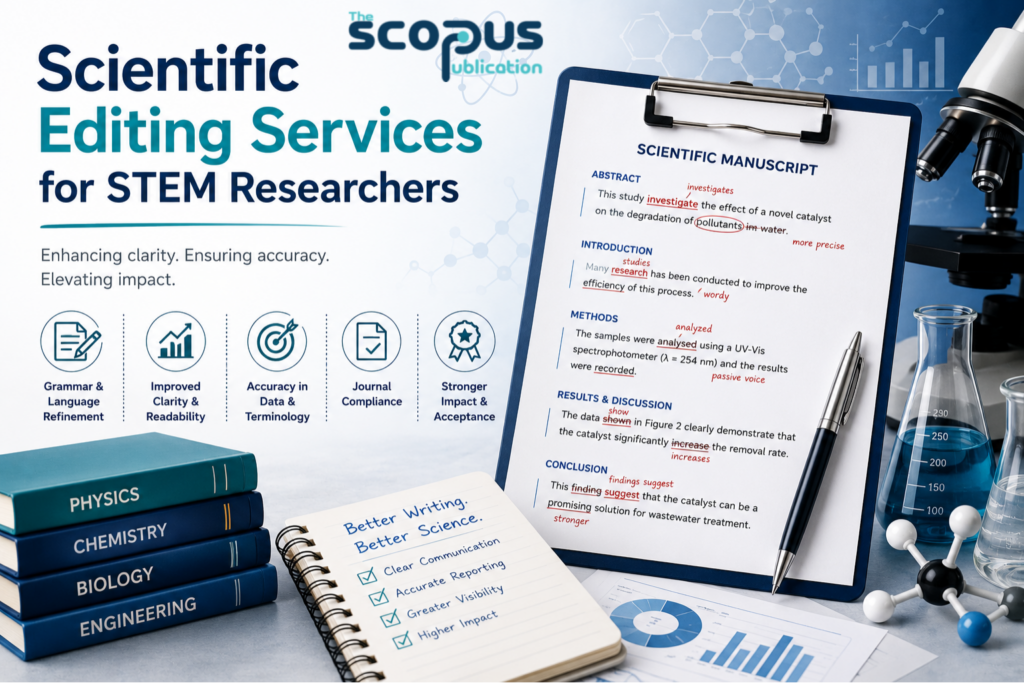
Most researchers believe that their paper will be evaluated based on its scientific merit mostly. However, here is the truth behind this: language and presentation problems, rather than imperfect methodology are some of the leading causes of manuscript rejection by desk in Q1 and Q2 journals.
This is where scientific editing services are very important.
Scientific editing does not only consist of proofreading. It is a multi-layered process that checks both the structure, logic, technical accuracy, statistical reporting, figure clarity and language to ensure that your manuscript meets the expectations of peer reviewers before submission.
This is even more crucial to STEM researchers. A general editor will not be able to tell you whether your methodology can be reproducible, whether your statistical tests are correct or your conclusions are logically justified.
This guide will tell you what scientific editing is, why it is important, and how it will help you get your manuscript in successfully to publications.
What is scientific editing?
The expert review and improvement of a research manuscript by a qualified editor with domain knowledge in the relevant STEM field addressing content, structure, logic, language, and compliance with target journal requirements.
Scientific editing defined
Scientific editing goes beyond language correction to evaluate the integrity of the research itself. A scientific editor provides answers to the questions every peer reviewer will ask:
- Does the research argument make sense?
- Can the methods be reproduced?
- Do the results support the conclusions?
- Are figures and tables correct and clearly presented?
- Does the language meet the target journal’s standards?
Unlike proofreading or general copyediting, scientific editing requires subject-specific knowledge from a qualified editor in your field.
What scientific editing is not
- Not peer review
- Not ghostwriting
- Not a guarantee of acceptance
It is a risk-cutting measure that your manuscript will not be rejected as a result of preventable problems.
Scientific editing vs. standard proofreading – the critical difference
What a Proofreader Does
- Corrects grammar and spelling.
- Corrects punctuation
- Adjusts formatting
- Aligns references
What a Scientific Editor Does
A scientific editor works at multiple levels:
| Editing Layer | What Is Checked | Why It Matters |
| Structure | Logical flow, IMRAD format | Prevents reviewer confusion |
| Scientific logic | Valid conclusions | Avoids overclaiming |
| Technical accuracy | Correct terminology | Builds credibility |
| Statistical validity | Proper tests/reporting | Prevents rejection |
| Figures & tables | Consistency with text | Eliminates discrepancies |
| Language clarity | Precision and readability | Improves comprehension |
| Guidelines compliance | Journal requirements | Avoids desk rejection |
Why peer reviewers reject stem manuscripts and how editing prevents it
Top Causes of Rejection
- Poor language quality
- Scope mismatch
- Weak methodology description
- Overstated conclusions
- Statistical errors
- Inconsistent data presentation
Research indicates that more than 40 percent of rejection of a review by reviewers is due to problems with language and presentation- not the science.
How scientific editing fixes these issues
| Problem | Editing Solution | Result |
| Weak language | Native-level editing | Clear communication |
| Missing details | Reproducibility check | Strong methods section |
| Overclaiming | Logic review | Balanced conclusions |
| Statistical errors | Data validation | Reviewer confidence |
| Formatting issues | Journal compliance check | Smooth submission |
Rejected a manuscript and not sure why? Our scientific editing team pinpoints what was marked by peer reviewers, and corrects it before your next submission.
Had a manuscript rejected and not sure why?
We identify what peer reviewers flagged and fix it.
Our scientific editing team reads your manuscript through a reviewer’s lens, pinpointing every issue that triggered rejection language, structure, or methodology gaps and resolves them before your next submission.
Why stem disciplines require subject-specific scientific editing
The Problem with Generic Editors
A general editor is not able to judge:
- Biological mechanisms of proteins.
- Engineering design validation
- The performance of machine learning models.
- Chemical reaction conditions
It is not sufficient that language clarity is present but it must be technically accurate, which means that it must have domain knowledge.
Discipline-specific editing examples
| Field | What Editors Check | Common Issues |
| Biomedical | Protocol accuracy | Overstated clinical claims |
| Engineering | Technical standards | Ambiguous methods |
| Computer Science | Algorithm clarity | Missing benchmarks |
| Chemistry | Nomenclature accuracy | Inconsistent naming |
| Medicine | Statistical methods | Incorrect test usage |
| Environmental Science | Data interpretation | Overstated conclusions |
| Physics/Math | Notation consistency | Missing derivations |
Scientific editing for non-native English stem researchers
The Language Barrier in Publishing
Non-native speakers of English create more than 60 percent of research, but English is dominant in academic publishing.
This poses an issue:
- Strong research
- Weak expression
Even minor problems with language can have an impact on the perception of the review.
Scientific Editing Provides
- Native-level academic English
- Improved clarity and readability
- Correct academic tone and structure
- Idiomatic precision
Editing vs Translation
- Editing – enhances English manuscript.
- Translation – converts language
To secure the greatest possible returns, write in English, and then subject to scientific editing.
The four layers of professional scientific editing
1. Structural Editing
- Coherent structure of passages.
- Clear research gap
- Strong discussion alignment
2. Technical Accuracy Review
- Correct terminology
- Reproducibility of methods
- Valid conclusions
3. Data Presentation Review
- Figure clarity
- Table consistency
- Statistical correctness
4. Language and Compliance Editing
- Grammar and style
- Journal formatting
- Reference accuracy
Making your manuscript journal-ready
Final checklist
Before submission, ensure:
- Abstract clearly summarises study
- Introduction defines research gap
- Methods allow replication
- Results present data clearly
- Discussion avoids overclaiming
- References are accurate
- Figures are consistent
- Cover letter is tailored
After scientific editing, your manuscript meets reviewer-ready standards.
What to expect from a professional scientific editing service
The Editing Process
- Submit manuscript + journal details
- Editor matched by subject expertise
- Multi-layer editing applied
- Receive tracked changes + report
- Optional revision support
Turnaround Time
- Short papers – 3–5 days
- Standard papers – 5–7 days
- Long papers – 7–10 days
- Thesis – 2–4 weeks
Ready to hand in confidently? Your manuscript will be prepared to journal-ready standard by our PhD-qualified scientific editors. Ask to receive your free sample edit today.
Frequently Asked Questions
Grammar is corrected by proofreading; structure, logic, and technical accuracy are improved by scientific editing.
Yes, even scientific clarity and structure must be subjected to the expert examination.
Depends on the length and complexity.
No, but it makes rejection risk much less.
Find topic-specific editors and revision guarantees.
Conclusion
Scientific editing is much more than a final language polish–it is a comprehensive process that makes your manuscript ready to fit the very strict standards required by journal editors and peer reviewers. In STEM-based research, where precision, clarity, and technical accuracy are paramount, the use of generic proofreading alone is a risk that most researchers cannot afford to take. A properly edited manuscript not only makes sure that your ideas are conveyed in a clear manner but it also makes sure that your methods can be reproduced and that your conclusions are consistent with your data.
Not following this step can result in unnecessary delays, such as repeated rejections, protracted revision processes, and lost publication opportunities. Such delays not only delay your academic achievement, but it can also affect funding, promotions, and the visibility of your research. Conversely, scientific editing will greatly enhance the readiness of your manuscript to be submitted and minimize the possibility of rejection because of presentation problems.
In the end, scientific editing enables the reviewers to concentrate on what is really important- your contribution to research- but not to get distracted by the mistakes that can be avoided.
Preventable rejection of manuscripts should be prevented by not losing them. We have PhD-qualified scientific editors who have been able to prepare more than 2,000 STEM manuscripts to be submitted to journals.
Get your free 500-word sample edit today- no obligation.
Stop losing manuscripts to preventable rejection.
Our PhD qualified scientific editors have prepared 2,000+ STEM manuscripts for successful journal submission. Get your free 500 word sample edit today no commitment required.