
Most PhD students complete a 60,000-word thesis then discover their university expects them to publish it in 6,000 words. Almost nothing transfers directly.
If you have ever stared at a completed thesis and wondered how to compress years of research into a peer-reviewed article, you are not alone. This structural gap between a thesis and a journal article is one of the most common and most underestimated challenges in academic publishing. Understanding it is not just useful; it is essential for publication success and long-term career progression.
This article walks you through the exact structural differences between the two formats, explains why they exist, and shows how professional thesis editing services support PhD students through this critical transition.
What you’ll learn:
- Why the thesis-to-journal gap causes manuscript rejection
- The complete architecture of a PhD thesis vs a journal article
- A step-by-step process for converting a thesis chapter into a publishable article
- What to look for when choosing professional thesis editing services in the UAE and beyond
Why the Thesis–Journal Gap Causes Publication Delays
The root cause of most publication delays is a fundamental mismatch in purpose. A PhD thesis is evidence of learning it demonstrates to examiners that you have mastered your field, applied a rigorous methodology, and made an original contribution. A journal article, by contrast, is a contribution to knowledge it advances a specific academic conversation for an expert audience that already knows the field.
These are not just different lengths of the same thing. They are different genres, written for different readers, with different success criteria.
When PhD graduates submit thesis chapters as journal manuscripts, reviewers return them for major structural revision not because the research is weak, but because the manuscript does not follow article conventions. Studies on first-submission manuscript outcomes consistently show that structural non-compliance is among the leading reasons for desk rejection. The problem is widespread, not a sign of individual failure.
Thesis vs Dissertation Clearing Up the Confusion for UAE/GCC Students
For students in UAE and GCC universities, there is an additional layer of confusion around terminology. In the UK and Commonwealth academic tradition which influences many regional institutions a thesis refers to a PhD-level document, while a dissertation is typically a Master’s-level work. In the US system, these terms are often reversed. Knowing which convention your institution follows matters for formatting, submission requirements, and when seeking academic writing support.
The good news: the structural differences between thesis and journal article are learnable. This is precisely what professional editing addresses.
The Architecture of a PhD Thesis: What Makes It Unique
A PhD thesis serves a very specific purpose to demonstrate comprehensive knowledge, methodological competence, and an original contribution to your examiners. Every structural element flows from that purpose.
Standard Thesis Structure
- Title
- Abstract
- Table of Contents
- Introduction
- Literature Review
- Methodology
- Results
- Discussion
- Conclusion
- Bibliography
- Appendices
Length and Depth Expectations
A thesis literature review can run 15,000 words or more. Its job is to map the entire scholarly landscape of your topic, demonstrate your command of it, and justify your research gap. A journal article’s literature review, by contrast, rarely exceeds 500 words its sole function is to contextualise your specific claim.
This difference in depth runs through every chapter. Thesis methodology sections explain and justify every procedural decision in exhaustive detail. Thesis conclusions revisit the full arc of the research journey. None of this is wasteful it is precisely what examiners need to assess.
Thesis Formatting Requirements
PhD thesis formatting is governed by institutional templates that specify citation norms, chapter numbering, margin widths, font sizes, and page layout. UAE universities each maintain their own submission guidelines, and non-compliance can delay examination regardless of research quality. Thesis structure editing services are routinely engaged at this stage to ensure formatting compliance before final submission.
Thesis voice also varies by discipline. Some fields permit first-person narration; others demand third-person throughout. Hedging language phrases that qualify claims carefully is expected and rewarded in a thesis, where comprehensive caution signals scholarly maturity. In a journal article, excessive hedging reads as uncertainty.
The Architecture of a Journal Article: What Peer Reviewers Expect
A journal article has one job: to advance a specific research conversation by making a focused, defensible claim. Every word that does not serve that purpose weakens the manuscript.
The IMRAD Framework
Most peer-reviewed journals in STEM, social sciences, and health disciplines operate on the IMRAD framework.
Standard Structure (IMRAD)
- Introduction
- Methods
- Results
- Discussion
This structure is not arbitrary; it mirrors the logical sequence of scientific inquiry and allows expert readers to navigate manuscripts efficiently. Journals that do not explicitly require IMRAD still reward its underlying logic.
Word count reality is unforgiving. Journal articles typically run between 4,000 and 9,000 words. Compressing a 60,000–100,000 word thesis into that range requires conceptual restructuring, not editing.
What a Thesis Editing Checklist Should Cover Before Journal Conversion
Before beginning conversion, a thesis editing checklist should address:
- argument focus
- literature review scope
- methodology brevity
- discussion clarity
- tone
Tone and Style
- Assumes expert readers
- No repetition or teaching tone
- Direct and precise
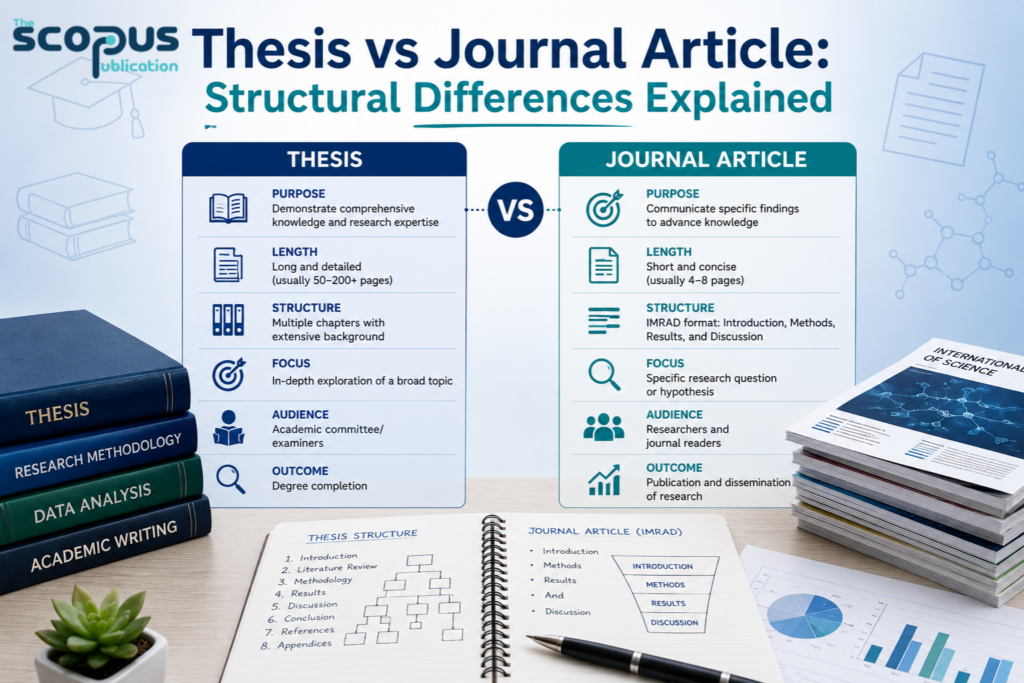
Thesis vs Journal Article — Key Differences
| Feature | PhD Thesis | Journal Article |
|---|---|---|
| Purpose | Evidence of learning for examiners | Knowledge contribution for expert peers |
| Length | 60,000–100,000 words | 4,000–9,000 words |
| Audience | Examination committee | Field-specific expert readers |
| Literature Review | 10,000–20,000 words | 300–600 words |
| Voice | Pedagogical, comprehensive | Concise, assumes prior knowledge |
| Appendices | Extensive | Rarely used; supplementary materials only |
| Structure | Institution-defined chapters | IMRAD or journal-specific template |
How to Convert a Thesis Chapter into a Journal Article
Converting a thesis chapter to a journal article is not copy-pasting with cuts. It requires rebuilding the argument from the ground up.
Step 1 – Identify the single publishable argument
A thesis chapter often contains three or four publishable ideas. Choose one. Everything else is either supporting context or a separate future paper.
Step 2 – Compress the literature review.
Strip it back to only the sources that directly situate your specific argument. A journal introduction contextualises; it does not survey.
Step 3 – Rewrite the methodology section for journal brevity
Retain enough detail for reproducibility. Cut the justificatory scaffolding written for examiners who needed to assess your process competence.
Step 4 – Restructure results and discussion
In a thesis, results and discussion are often separated for examiner clarity. In many journals, they are integrated. Reframe findings in terms of their contribution to the field, not their relationship to your research questions.
Step 5 – Reframe the conclusion
A thesis conclusion revisits the full research journey. A journal conclusion states the contribution, its limitations, and future research directions concisely.
For UAE and GCC PhD students targeting international publication, Scopus-indexed journals at Q1 and Q2 ranking represent the standard benchmark for career advancement. Selecting the right target journal before restructuring not after saves significant revision time.
How Professional Thesis Editing Services Bridge the Gap
Professional thesis editing services do far more than fix grammar. At the structural level, they review argument logic, chapter coherence, formatting compliance, and publication readiness work that requires subject-specialist expertise, not general language proficiency.
Thesis Structure Editing
Structural editing reviews each chapter for internal logic, transitions between sections, alignment with the overall research argument, and conformity with institutional or journal requirements. This is distinct from proofreading, which addresses surface-level language errors.
Professional Thesis Proofreading
Proofreading is the final layer applied after structural and stylistic editing is complete. It addresses grammar, punctuation, spelling, citation formatting, and consistency. Submitting a thesis or manuscript to proofreading before structural issues are resolved wastes both time and investment.
Subject-specialist editors matter significantly at both stages. A biology thesis chapter requires an editor who understands biological research conventions not a generalist who corrects sentences without understanding the domain.
For students in the UAE, additional requirements apply: institutional submission portals with specific formatting rules, Arabic-English bilingual abstract editing, and compliance with national research output standards. Reputable thesis editing services UAE providers will be familiar with these requirements.
Typical turnaround times range from 3–5 days for chapters under 10,000 words to 10–15 business days for full thesis manuscripts, depending on the depth of editing required.
Choosing the Right Thesis Editing Service: What to Look For
Editor credentials
PhD-qualified subject specialists produce fundamentally different outcomes from general language editors. For thesis review, disciplinary expertise is not optional.
Structural editing vs proofreading
Know which service level your thesis needs at each stage. Pre-examination, structural editing is typically the priority. Pre-submission to a journal, structural editing followed by proofreading represents best practice.
Turnaround vs quality
When a supervisor deadline is immovable, turnaround speed matters. When preparing for journal submission, depth of review should not be sacrificed for speed.
Sample edit policy
Any reputable service should offer a free sample edit of a chapter section before full commitment. This allows you to assess editor quality and communication style before engaging.
Confidentiality
Your unpublished thesis contains pre-publication intellectual property. Verify that any editing provider operates under a formal non-disclosure agreement and clear data protection standards.
Frequently Asked Questions
A thesis is structured to demonstrate comprehensive knowledge to examiners across multiple chapters. A journal article makes one focused argument for expert peer readers, typically within 4,000–9,000 words using the IMRAD framework.
Proofreading alone is insufficient for conversion. You need structural editing to rebuild the argument for journal conventions, followed by proofreading before final submission.
Rarely. A thesis chapter typically contains multiple arguments and extensive examiner-facing content. Successful conversion requires identifying one publishable argument and rebuilding the manuscript around it.
Research paper editing focuses on a standalone manuscript already written to journal conventions. Thesis editing addresses a longer, differently structured document often as a precursor to journal conversion.
In Commonwealth academic tradition, a thesis is a PhD-level document; a dissertation is typically Master’s-level. US convention reverses these terms. Always confirm which terminology your institution uses.
Yes. Specialist providers offer thesis editing services UAE students can access remotely, with familiarity with local institutional requirements, bilingual abstract editing, and portal submission formatting.
Conclusion
Publishing from your thesis is not a matter of cutting word count and hitting submit. The purpose shifts, the structure must be rebuilt, and the voice has to change and closing that gap efficiently is where professional editing makes the clearest difference.
Three things to carry forward: thesis and journal article serve entirely different masters; your existing structure is a starting point, not a template; and expert editorial support is the fastest route from manuscript to submission-ready.
Ready to prepare your thesis for journal publication?
Our professional thesis editing services are delivered by PhD-level subject specialists across all disciplines so your work is reviewed by someone who truly understands your field.