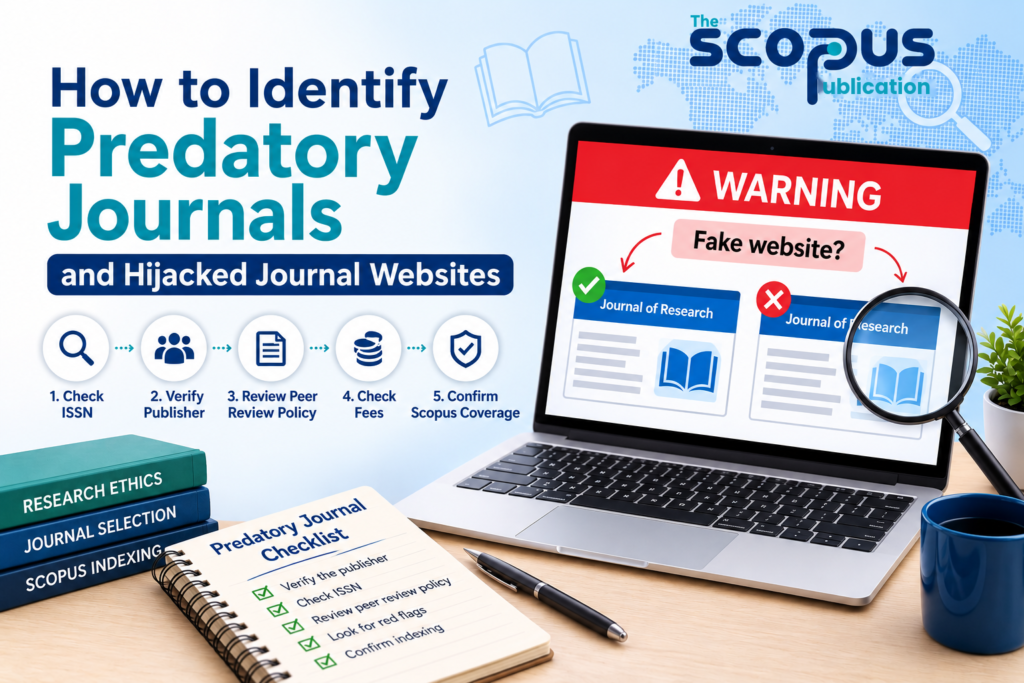
Key takeaways
-
Predatory journals may deceive authors regarding editorial review, fees or standards in publishing.
-
Hijacked journals are a fake website using the name of a real journal to attract researchers to it.
-
Verify independently the ISSN, publisher, review process and Scopus coverage of a journal.
-
Prior to submitting, or paying, use the predatory journal checklist below.
The e-mail shows up: an editor commends your research, and asks you for a quick turnaround, and submission today! However, is the journal authentic? Being aware of the characteristics of predatory journals can help you save months of work, your dollars, and your academic reputation!
What is a predatory journal?
Predatory journals are journals that deceive researchers in their academic standards or business practices. It could cover up charges, overpromise indexing results or provide little real peer review. A predatory operation prioritizes its own interests over trustworthy scholarship, as opposed to a genuine journal which will describe its editorial procedures.
Predatory vs hijacked journals: know the difference
A problematic publisher can publish its own journal and make bogus claims on quality. A hijacker does something else: it takes a familiar name. Cloned journal websites that mimic a legitimate journal’s name, ISSN, logo or old articles are a common way that hijacked journals appear on the Internet.
Imagine if you found a familiar title in a database, clicked on one of the search results and found a website that looks very similar. The name of its journal is authentic, but the website for submissions and payment information is not. You should check the site where you are submitting your paper, as well.
Warning signs you should never ignore
Multiple red flags should alert you to look into it.
-
Uninvited praise: A generic e-mail states that your work is groundbreaking; yet the sender has never seen the manuscript.
-
Rushed decision: The site offers an unusually quick acceptance, and there is no clear description of editorial review.
-
Vague editorial details: Editors do not have specified affiliations or their names can’t be verified via their institutions’ websites.
-
Fees that vary: Charges are not specified until deep into the process or the person who collects the fee isn’t the same as the publisher.
-
Unverifiable claims: The site shows impressive badges, misguiding metrics or database logos but doesn’t have links to actual records.
-
An unfamiliar Web address: Domain other than that of the trusted publisher.
Do not assume that a new journal with a small website is not legitimate.
How to Identify Predatory Journals: A Six-Step Verification Process
1. Start outside the journal’s website
Look for the journal title and ISSN in another source. Registration of serial identity can be done with the help of ISSN Portal. An ISSN is used for a serial and does not verify the integrity of any entity running a website with the numbers.
2. Check who runs the publication
Look up the publisher’s official website via a trusted library record or independent search engine. Then click on the link that leads to the journal. Contact the publisher via information you get on your own, instead of the email from an unexpected invitation.
3. Read the peer-review and ethics policies
A reputable journal should state who the reviewers are, how ethical issues are addressed. Think. Check. Submit. recommends checking the review process, contact information, fees and professional memberships before submission.
4. Check fees before sharing your manuscript
Do not assume an article processing charge means it is a scam. It is the amount, timing, waivers and terms that matter. Within the DOAJ application criteria, they are looking for indexed open access journals to have their author fees and editorial policies easily accessible.
5. Inspect recent articles and editors
Open multiple papers from multiple issues. Are topics appropriate to the scope of the journal? Are there any tools for confirming editors on university profiles?
6. Verify the indexing claim yourself
Beware of a screen shot or a Scopus logo. Check the cover period of the journal by searching the title or ISSN in the official Scopus Sources directory. History does not demonstrate that a journal is being actively covered today.
Check our tips for choosing the right Scopus-indexed journal for a better short list.
How to Identify Predatory Journals When the Website Looks Genuine
Check if the address matches those of the publisher, as well as those of a university library and credible index entries. Pay attention to the address of the sender, as well as the address of the form to submit and instructions for payment. If these details don’t match, please check with the real publisher before posting anything.
How to spot fake Scopus journals in 2026
Fake Scopus journals can be journals that falsely state that they have been indexed on Scopus, or fake websites that mimic the indexed ones.
Obtain official source record and find a matching ISSN and coverage years. Next, make sure that the journal is truly published by the publisher of the website on which you intend to publish. Elsevier’s Scopus content policy as explained states that Elsevier’s selection board reviews journals and may discontinue coverage.
Your 60-second predatory journal checklist
Prior to submission, check through this list of indicators of a predatory journal:
-
Is the journal relevant to your paper’s topic and methodology?
-
Is there any way you can verify its title, its ISSN and its publisher on your own?
-
Is the website where the submission is made the publisher’s official website?
-
Are there any named editors and a clear peer-review policy?
-
Are publication fees, copyright terms and licences explained?
-
Is there any way to check any indexing claim directly with the index provider?
-
Are recently published articles credible and relevant?
-
Do you have a look at the email sender and payment information?
When a significant answer is not apparent, research before turning it in.
Already sent your manuscript? Here is what to do
Firstly, halt any payment and keep emails, invoices, web links and record of submissions. If you think you are being impersonated, send a message to the legitimate publisher with their verified contact information. If you’ve used the same password anywhere, change it there as well.
When you have sent a manuscript to a dubious journal, request its withdrawal in writing and retain a copy of the request. Before sending the paper somewhere else: simultaneous submission or prior online publication can cause ethical and copyright issues. Please use our pre-submission English editing checklist before resubmitting.
Frequently asked questions
Are all open-access journals predatory?
No. Open access is not necessarily about a journal’s trustworthiness, but rather about people’s ability to read research. Review Publishers, Editors, Review Process and fees. Directory of Open Access Journals listing is a good indication of eligible journals, but not the sole one to determine credibility.
Can a hijacked journal use a real ISSN?
Yes. Fraudsters can imitate a publication’s title and ISSN. Verify the publisher of the journal and visit its website or a different website to check the journal, not just via the ISSN that is given on the page. If in any doubt please contact the authentic publisher and request confirmation of the submission address.
Does a DOI prove an article or journal is legitimate?
No. A DOI is a permanent identifier designed to identify digital content. This does not certify a manuscript for sound peer review, nor that a journal is following responsible editorial practices. Don’t just click on a DOI, check the publisher, review policy, history of the article and claims of indexing.
What if a journal says it is indexed in Scopus?
If you have any doubts about the truth of the claim in Scopus Sources, check it out for yourself. Look for the ISSN and match with full publication title and then view the publication’s coverage information. A copy of a badge, a screen shot or an old indexed article do not prove current coverage. You must also be sure that you have the real publisher’s submission site. Though the inclusion in Scopus is a useful piece of information, it shouldn’t take the place of your broader trust assessments.
Is an invitation to publish always a scam?
Not necessarily. Sometimes real journal editors will call for papers on journals or special issues. The warning is an invitation that forces you to make hasty decisions, provides flattering remarks with no mention of your work or leads you to an unconfirmed website. Check the journal on its own and if something does not sound right, reach out to the editor using an institutional email address and the details in the special issue.
Conclusion: protect the work behind your paper
Knowing how to identify predatory journals isn’t about one big red flag; it’s about examining the facts. Check the journal’s ownership, find the actual submission site, understand the peer review process and if database claims are accurate. Some diligent precautions can save you a big expense.
Help with selecting an appropriate journal and formatting your paper? Check out The Scopus Publications’ journal publication services for journal-selection guidance, formatting and submission assistance. Take informed steps towards the next step in your publishing journey.