Key takeaways
-
Decisions are not equal to acceptance or publication; compare the measures of each journal.
-
Peer review and author revisions can take months, and online publication and Scopus indexing are separate processes.
-
Journal fit, complete files and a realistic revision plan can help avoid preventable delays.
-
Use journal-specific data to guide, but do not use it as a guarantee for your paper.
You have now submitted your paper, notified your co-authors, and begun to monitor the email queue. Then there’s a college due date on the calendar, and the deadline is looming closer. When you ask how long it takes to publish in a Scopus journal, it depends on the milestone you need: a decision, an accepted paper, an online published paper, and a record published in Scopus.
How long does it take to publish in a Scopus journal?
No fixed time frame. At Springer Nature, the peer review for a full research article takes 3 to 6 months, with revisions, production and indexing taking further time. Some papers manage to get published quickly; some papers get published slowly; some papers are rejected. Look for published metrics of the target journal and leave some margin for each of the stages.
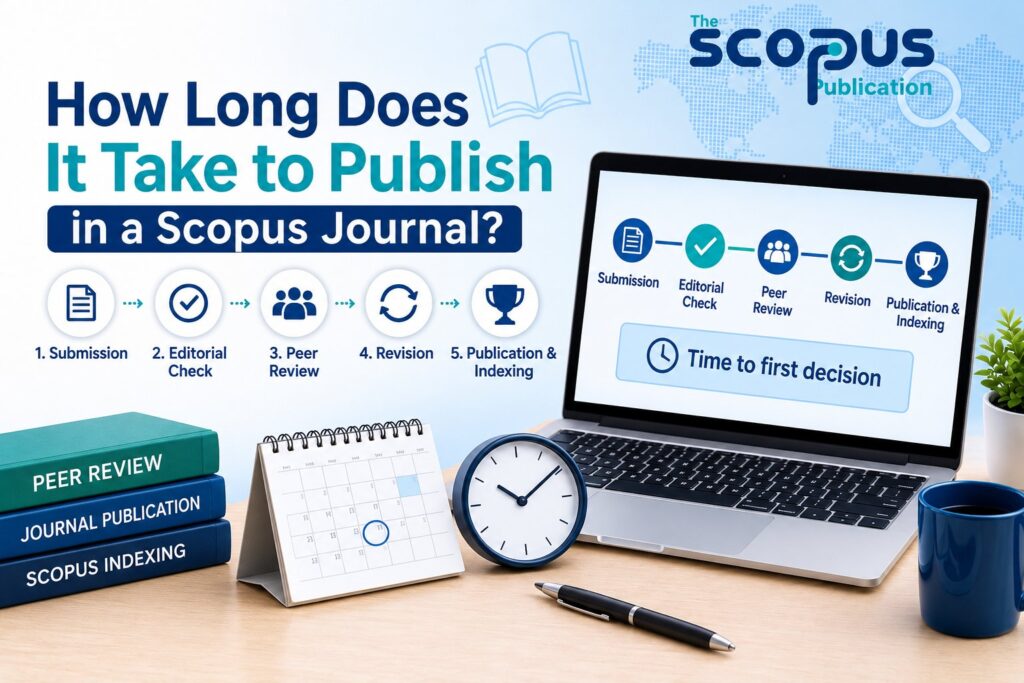
A realistic journal publication timeline
The following is a planning example, not an industry average and not a promise. One paper can be rapidly processed in the same journal, while a second is languishing for appropriate reviewers or further revisions.
-
Initial checks and editorial screening: approximately 1-4 weeks. The office reviews the documents and an editor evaluates the paper’s scope and suitability. Often, journals make a decision early; other journals later.
-
External review: allow roughly three to six months as one publisher’s typical range for a full research article. Reviewers must be invited, agree to review, and return their reports.
-
Author revisions and further decisions: reserve several weeks or more. The process of minor changes can be brief, but it can last longer if new analyses are done, if the changes are subject to co-author approval or another review round.
-
Acceptance to online publication: accept for up to a few more weeks after copyediting and proofreading and production. Different processes follow different metrics, so check the journal’s own.
-
Scopus indexing: check after online publication, do not use a fixed number of weeks as a deadline. The occurrence of a record may be influenced by coverage and data delivery.
These steps are overlapping in journal statistics. In some cases, submission-to-acceptance rates may already incorporate revision time, such as in the case of a submission and an acceptance, for instance. Incorporating them in an independent review-and-revision estimate would be double-counting some time.
How long does it take to publish in a Scopus journal after revision?
There is no definitive answer to this question. After viewing your response, the editor might make a decision, or he may invite reviewers again. Even a short revision can be held in an editor’s queue. Discuss with the journal the meaning of the revision deadline and then send a clear response letter along with the files requested.
What the time to first decision actually tells you
A rapid time to first decision can be useful, but read its definition. At Nature, the current journal metrics report a median of eight days to first editorial decision and 321 days from submission to acceptance. Its first decision may send a paper for review or reject it; eight days is therefore not eight days to acceptance.
A median is the middle observation, not a deadline for your own manuscript. Journals may also define “first decision” differently. Before comparing data, make sure they encompass all papers submitted or only those that were sent for peer review, and determine the time period covered and whether the measure was used to prevent revisions or to stop revisions.
If a journal only indicates the peer-review time, query what this time refers to. Is it the time between the submission and first decision following review or is it the time reviewers have with the paper? The difference could mean weeks or months in the estimate.
What can slow down Scopus publication time?
Finding the right reviewers
In a specialist paper, reviewers might need to have specific expertise. Some have to say no to an invitation and some require time. The review period might be influenced by the availability of the reviewers, according to Elsevier. It’s not possible for an editor to always know that an invitation will be accepted.
A mismatch between paper and journal
A paper that is not in the scope of publication of the Journal will be rejected prior to its consideration for publication. From there, you can now edit and submit to another place; meanwhile the clock will start again. Read recent papers, the aims and scope and the article type rules. The choosing the right Scopus-indexed journal guide describes what exactly needs to be checked.
Missing information or complicated revisions
Review may result in a request for an ethics statement or incomplete figure file/disclosure of data availability problems. Subsequent request for additional analysis, in particular, might take longer than anticipated. In advance, agree upon who will respond to each comment and who will be able to clear up changes if one of the co-authors is on vacation.
Production and author proof corrections
The published article is prepared by the publisher after it has been accepted. Authors might have to review proofs, go over production queries and validate publication information. A prompt and careful response helps avoid delays at this stage.
Online publication, issue assignment and indexing are different
An accepted manuscript is not necessarily published. Online publication makes the article available on the journal’s site; assignment to a volume or issue can come later. An article may have a DOI before it appears in a final issue, depending on the publisher’s workflow.
A Scopus record is a further step. Elsevier’s content-coverage guide reports an average of two to three weeks after publisher website publication for fully indexed article data, based on its described processing system. Treat that as a published historical average, not a current service promise: individual cases and coverage arrangements differ.
If a record is missing, check the title, DOI, journal coverage years and publication status. Check with your publisher if metadata has been provided. The official source list can help you check journal coverage; inclusion of a journal does not mean every article or year is automatically covered.
How to choose fast Scopus journals responsibly
When time is short, speed is important, but with a very short advertised review period, questions should be raised. Choose a journal in your topic field, with an article type, that provides information on the journal’s editorial process and any fees. Check its title and its ISSN in Scopus, not on a journal website.
Compare the same metrics with journals: From submission to decision; Decision after review (if provided); From submission to acceptance; and from acceptance to online publication. Look at dates on the figures. When a speed claim is made, but no definitions are included, you don’t know much about what goes on after submission.
The best method of reducing your own journal publication timeline will be to minimize work you can control. Produce and bring a full submission, ready with figures and statement and reply in a structured form to revision requests. For language and presentation checks before sending the paper, see our guide to scientific editing for research papers.
Frequently asked questions
Is it possible to publish in a Scopus journal within a month?
While an individual paper might show up quickly, one month is too soon to plan a new submission that needs complete peer-review. Ask whether an advertised timeframe refers to the first decision, acceptance or online publication. A quick first decision may be a rejection or an invitation to review, not publication.
Does paying an article processing charge make publication faster?
No. At a reputable journal, the article processing charge covers publishing costs after acceptance; it does not shorten peer review or guarantee acceptance. Be careful with any journal that offers faster acceptance in return for payment.
What if the paper has been under review for months?
Check the descriptions of the status in the journal and from any available published information. If your paper had been submitted before the time of the journal, the editor’s office should be contacted politely with the paper ID and date of submission. Request that their work be updated but do not follow up their work with email to any reviewers.
Can I submit the same manuscript to multiple journals?
Do not simultaneously submit articles to two or more journals where journals do not permit double submission. Please do not submit elsewhere until communication with the withdrawals has been confirmed in the first journal. Please refer to journal specific information regarding preprints or manuscripts published elsewhere.
Will a Scopus-indexed journal always have my article indexed?
Not necessarily. Coverage varies with the journal, the year and type of article published, and journal coverage will vary. See the latest source information and years of coverage on Scopus, and also check with the publisher if necessary to verify the status of your published article. A DOI or a journal’s indexing claim alone is not proof that your particular article is indexed.
Conclusion
So, how long does it take to publish in a Scopus journal? Consider multiple phases and give months for review and revision and also take note of your institution’s actual milestone. With a well-thought-out journal and complete files, you can be ahead of the game while waiting.
If you are unsure about the proper fit of a journal or need assistance with submission, check out our journal publication services.