Key takeaways
-
Published prices differ depending on editing type, word count and deadline. Pay attention not only to pricing but also to services provided.
-
The lowest price for standard proofreading is $0.021 per word while for full editing – $0.05 per word according to one source.
-
Such rates would result in prices of $105 and $250 for editing of 5,000 words respectively.
-
Ask for an estimate specifying time frame, scope, taxes and re-editing if required.
It is difficult to compare an edit quote where one business offers “proofreading” services and another offers “advanced editing” but does not clarify the difference before you pay the fees. The English editing cost will depend on what kind of service you require, how many pages, and by what time frame you need it completed.
How much does English editing cost for a research paper?
The published rates differ. According to Academic Research Editors, proofreading will be done at $0.021 per word in seven days, and full editing at $0.05 per word. With these rates, a paper of 5,000 words will cost $105 and $250 respectively prior to any added costs.
English editing cost in 2026: real price examples
The following rates are provider rates as quoted on 6 November 2026. These do not represent a market average, nor do they represent prices set by Scopus Publications. Service levels vary. Ask for an up-to-date quote before ordering.
-
Academic Research Editors: basic 7-day proofreading, $0.021 per word, full editing, $0.05 per word.
-
Academic Research Editors: urgent 48-hour proofreading, $0.031 per word, full editing, $0.075 per word.
-
PaperSage: scientific clarity editing starts at $0.07 per word, $150 minimum. Substantive scientific editing starts at $0.12 per word, $300 minimum.
How English editing cost changes with paper length
Below are the calculations based on the first service provider’s regular prices for one week. For the purposes of the examples, every word is billable and there are no extra costs. Please have the provider confirm the word count and the price.
-
3,000 words: proofreading $63 (approximately AED 231 or SAR 236). Full editing $150 (approximately AED 551 or SAR 563)
-
5,000 words: proofreading $105 (approximately AED 386 or SAR 394). Full editing $250 (approximately AED 918 or SAR 938)
-
8,000 words: proofreading $168 (approximately AED 617 or SAR 630). Full editing $400 (approximately AED 1,469 or SAR 1,500)
The conversions are done using about AED 3.6725 and SAR 3.75 for every US dollar. These figures are just estimates, which do not take into account credit card commissions, fees and taxes that could change the total sum you have to pay. The exchange-rate data from the central banks of the UAE and Saudi Arabia are used here.
Proofreading or editing: what are you paying for?
Proofreading is the way to go once you have your argument and structure sorted out. Proofreading usually covers grammar, spelling, punctuation, and formatting. A proofreader can notice a misused comma but may or may not reorder a confusing methods section depending on the level of editing offered.
Language editing involves more detailed analysis of the sentence structure and word choice. Substantive editing might also include checking how the sections and concepts interlink. Terms are not standard and “full editing” is not a sufficient term because you need to know what tasks the editor performs.
Imagine the case where one comes across a paragraph where the use of “patients,” “participants,” and “subjects” changes yet there is no explanation of whether they mean the same thing. While light proofreading will fix the grammatical issues, deeper language editing may point out the inconsistency. However, it all depends on the researcher. The researcher ultimately decides what is scientifically precise.
For a closer look at levels of support, read our article on scientific editing for research papers. Our guide to professional English editing also explains how language review can support clear communication.
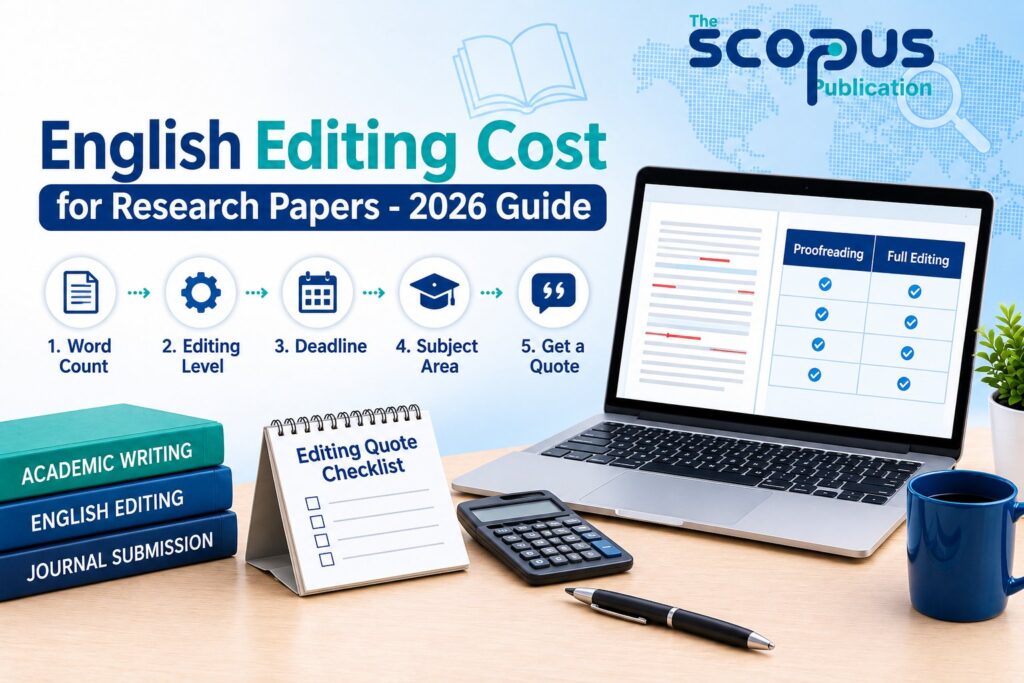
Five factors that affect your research paper editing cost
1. Billable word count
Some providers count the abstract, references, tables and figure legends. Others let you exclude some sections. The file may contain far more words than what might be appropriate for a paper that is limited to 5,000 words in the main text of a journal. Provide a copy of the document, or a count of the sections.
2. Depth of work
A clean draft with sentences that require only a final editing is likely to require less intervention than a paper with unclear sentences throughout. If the job is more comprehensive, it could cost more as well. If proofreading doesn’t solve the problems you have, then a low proofreading cost per word is not worth it.
3. Turnaround time
A two-day turnaround can cost more than a one-week service. The published full-editing rate at Academic Research Editors increases from $0.05 per word for seven days to $0.075 per word for 48 hours. That’s $250 for 5,000 words, versus $375 before any extras.
4. Subject expertise
A genomics paper will require an editor who is familiar with gene names and technical language. A legal study requires other skills. Explain to the editor how their background is related to your topic and whether the quote includes checks for terminology. Editing does not replace a specialist review of your research methods.
5. Extra services and follow-up
Reference formatting, journal layout, cover letters and revision-round edits may be included, limited, or charged as an extra service. Short papers may also be affected by the minimum cost of orders. Ask whether the cost includes the post-review editing and any limitations on the number of words and time for this work.
How to compare academic editing rates fairly
Quote the same manuscript and the same deadline. An important comparison is the word count, the service level, the delivery date, and whether figures, references, and additional files are included. Instead of comparing only the headline price, you have to ask for the final price, which includes tax, if any.
Verify the output. Track changes will enable you to either accept or reject changes. Comments should alert you about places requiring your decision. You should inquire about who has access to your manuscript, how the editor stores your manuscript, and whether the editor can help you answer questions related to your manuscript.
A certificate will inform you whether editing was done, if your journal requires one. It does not mean that your paper has been accepted by the journal. Editing will help improve your manuscript’s presentation. However, the responsibility for the research and data belongs to the authors.
How to find affordable English editing without cutting corners
Begin with your own self-edit. Do not duplicate text, make sure all co-author feedback has been taken care of, and ensure that you do not exceed the word count required by the journal before getting a quote from the editing company. There is no need to pay for editing text that you will later delete.
When budget is tight, inquire about editing only the abstract and the body of the paper and maintaining the essential parts of the document intact. See whether your organization has a language center, negotiated discount or a publication fund. A longer deadline may also lower the manuscript editing price.
You should not base your decision solely on the price. The company should provide a description of the services, maintain confidentiality and allow you to review any changes made. When the quote offered is abnormally low, find out who will be editing the document, the allotted time, and what will be done in case of ambiguity in the text.
Frequently asked questions
Do references count toward the editing word count?
It depends on the editor and the nature of the work. Some count words including references, some do not or charge separately for formatting them. It is best to obtain in writing the billable number of words and specify whether you need reference style checking. Formatting check is different from verifying each citation.
Is editing charged per word or per page?
Both methods are common as some charge hourly or for the whole project. If an editor quotes a price per page, it needs to specify either the number of words or the amount of formatting on one page. For comparison with a per-word quote, calculate your manuscript word count.
Should I edit my paper before or after choosing a journal?
Select a potential journal in advance before the final editing stage whenever possible, since it will provide guidelines concerning the target audience, page restrictions, spelling norms, and formatting requirements. In case there are some pending issues concerning your analysis or argument, it is best to resolve them beforehand, otherwise, editing sentences that will be rewritten again will be an additional expense.
Is an expensive editor always better?
No. An elevated price might indicate fast deadlines, more advanced editing or specialization of the editor, but it does not necessarily mean that this particular service will be suitable for your manuscript. Compare the written scope of services, appropriate qualifications, privacy policy and samples. Get the necessary level of assistance and review changes yourself.
Can editing improve my chances of publication?
Correctly expressed thoughts will allow the editor and reviewer to understand your research and its outcomes. But it is also important to keep in mind that a publication depends upon many other factors like research question, methodology, novelty, and compatibility with the journal. Language editing cannot compensate for the absence of evidence or influence the editor’s decision.
Conclusion
The English editing cost should depend on what your paper needs, not only on the cheapest price advertised. Compare the number of billable words, depth of editing, and deadline, and request a full quotation in writing before accepting.
Ready to get a quote for your manuscript? Browse through our English editing services and provide us with your word count, target journal and deadline.